
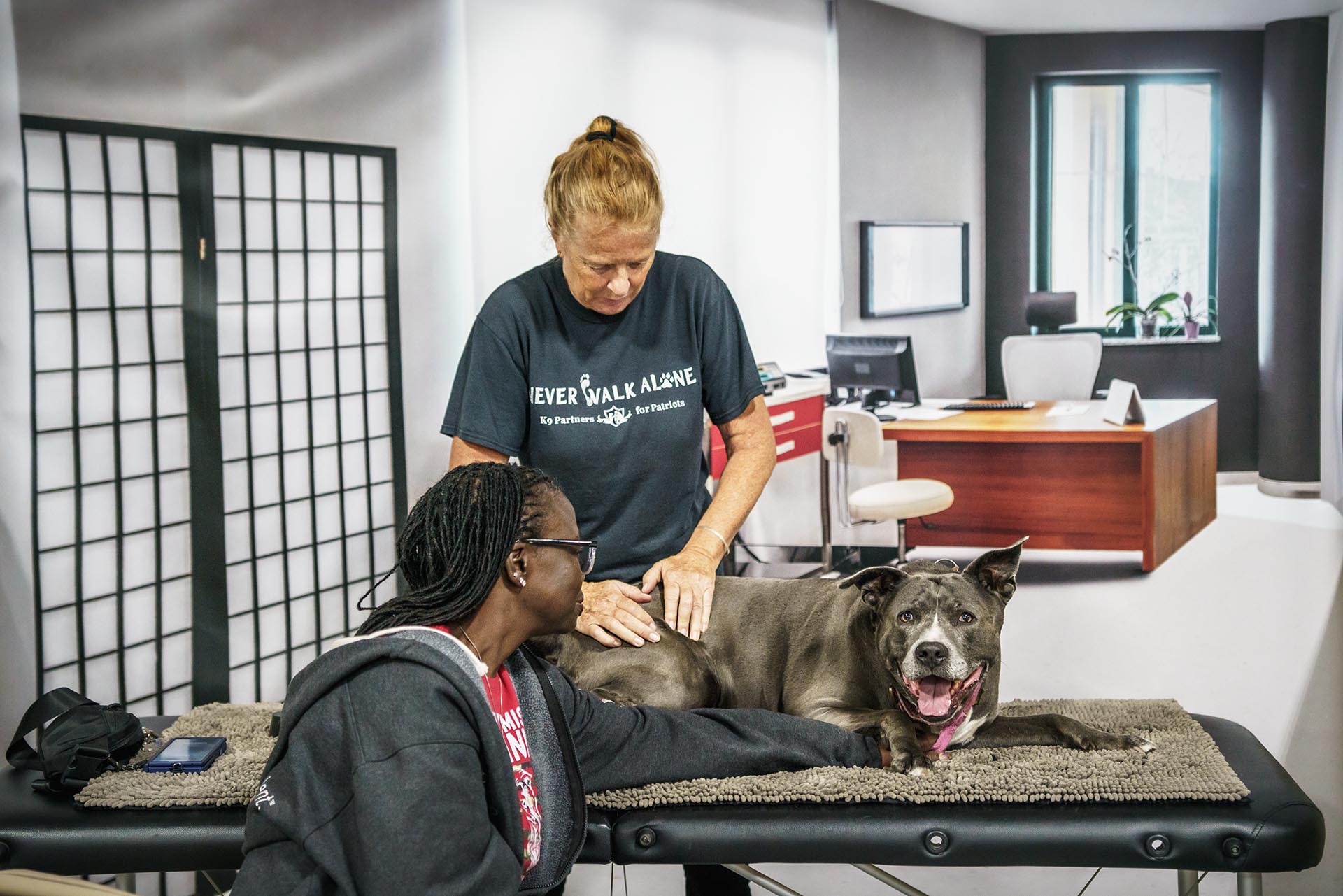
Dogs have a number of ways of telling you something hurts. Over the years, I’ve kind of figured it out. I’ve worked with nearly 3,000 dogs, and about 200 for K9P4P… everything from little 4-pound Yorkshire Terriers to 130-pound Bernese Mountain dogs!
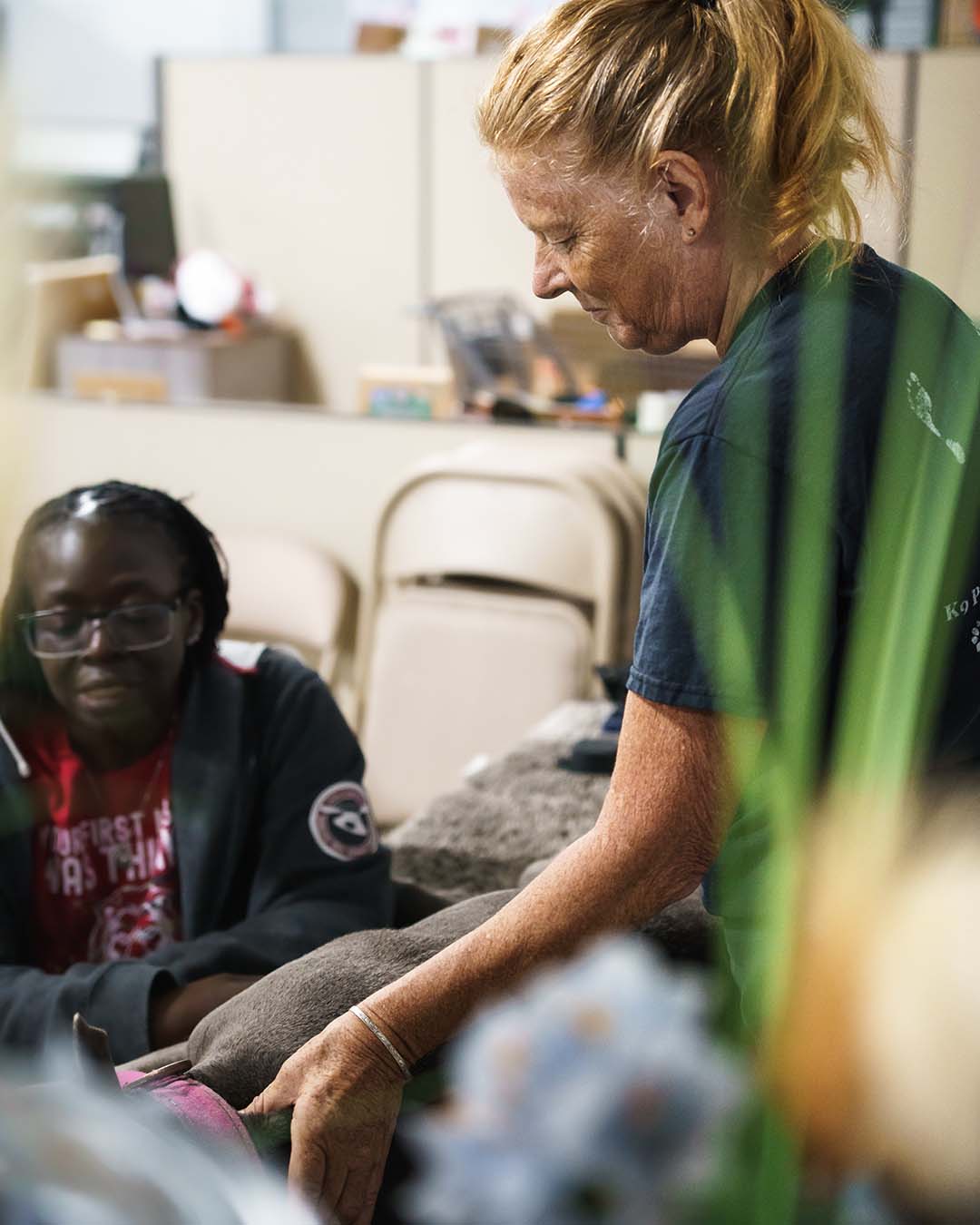
They’re apprehensive. I just get to work and I talk to them. People tell me ‘My dog will never sit there and let you do that, it’ll never happen!’ And then they do and the handler is open-mouthed and saying ‘I never thought it would do that!’
Most of them eventually settle down. Especially if they’ve got a trigger point. If they’ve got a sore area and you get to that, the dog gives me a look like ‘What are you doing? What are you doing? …Oh, that’s a bit uncomfortable.’ And very soon it’s ‘Oh, that’s what you’re doing… OK, that feels better!’
They get it and most of them enjoy their time with me.
I tend to read them pretty well. Especially if you’ve got a dog that’s in a lot of pain, then I will muzzle them and that will take the level of pressure down a little bit from the owner’s perspective. And then they’re not worried.
If the owner’s worried about you getting bitten and the dog is worried because of the owner — ‘why is the owner worried?’– It’s a chain reaction and the dog thinks this is something to worry about. When we put the muzzle on I can’t get bitten. I can’t get hurt. That takes the anxiety out of the equation, so I can concentrate on what I need to do and locate the problem area.
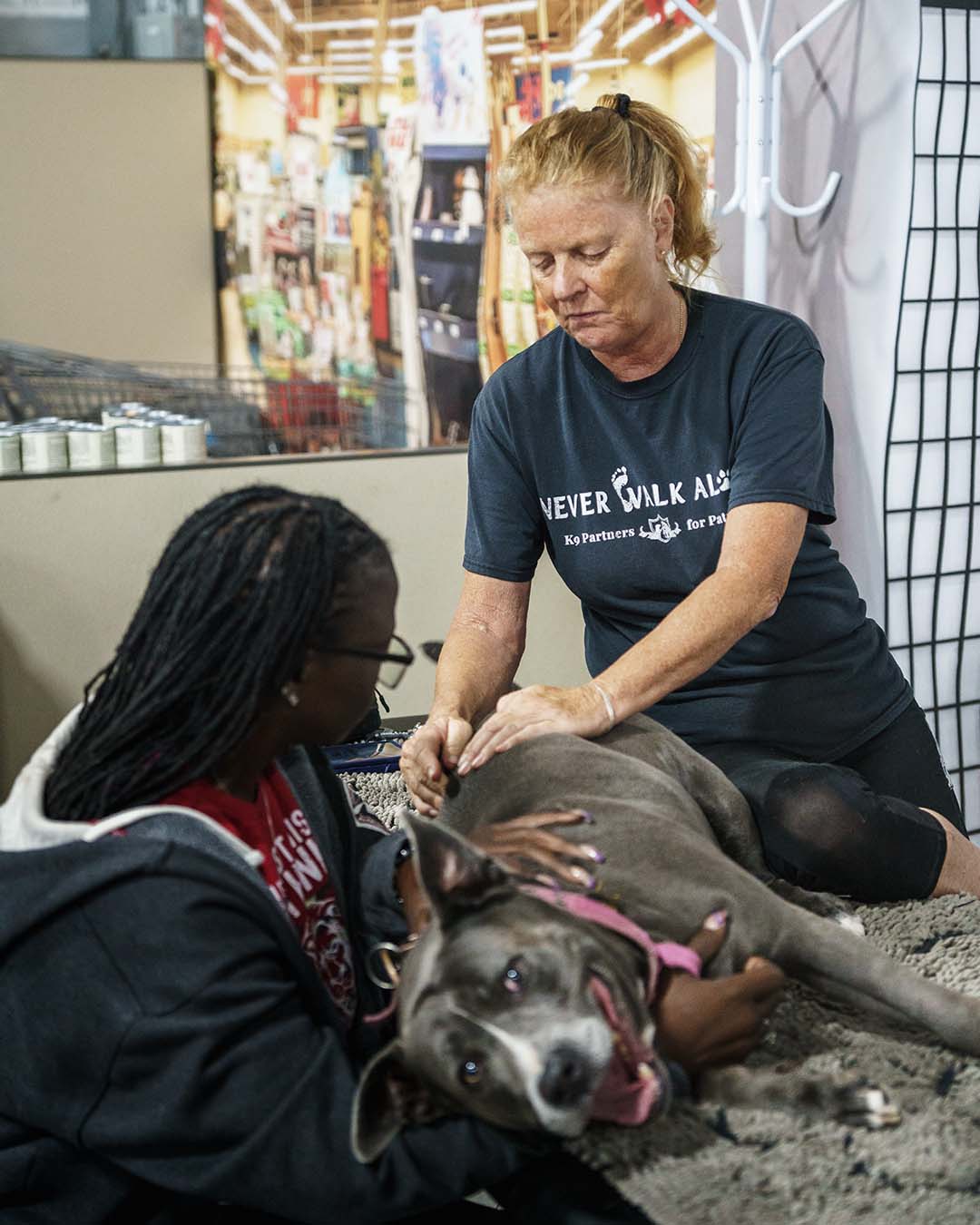
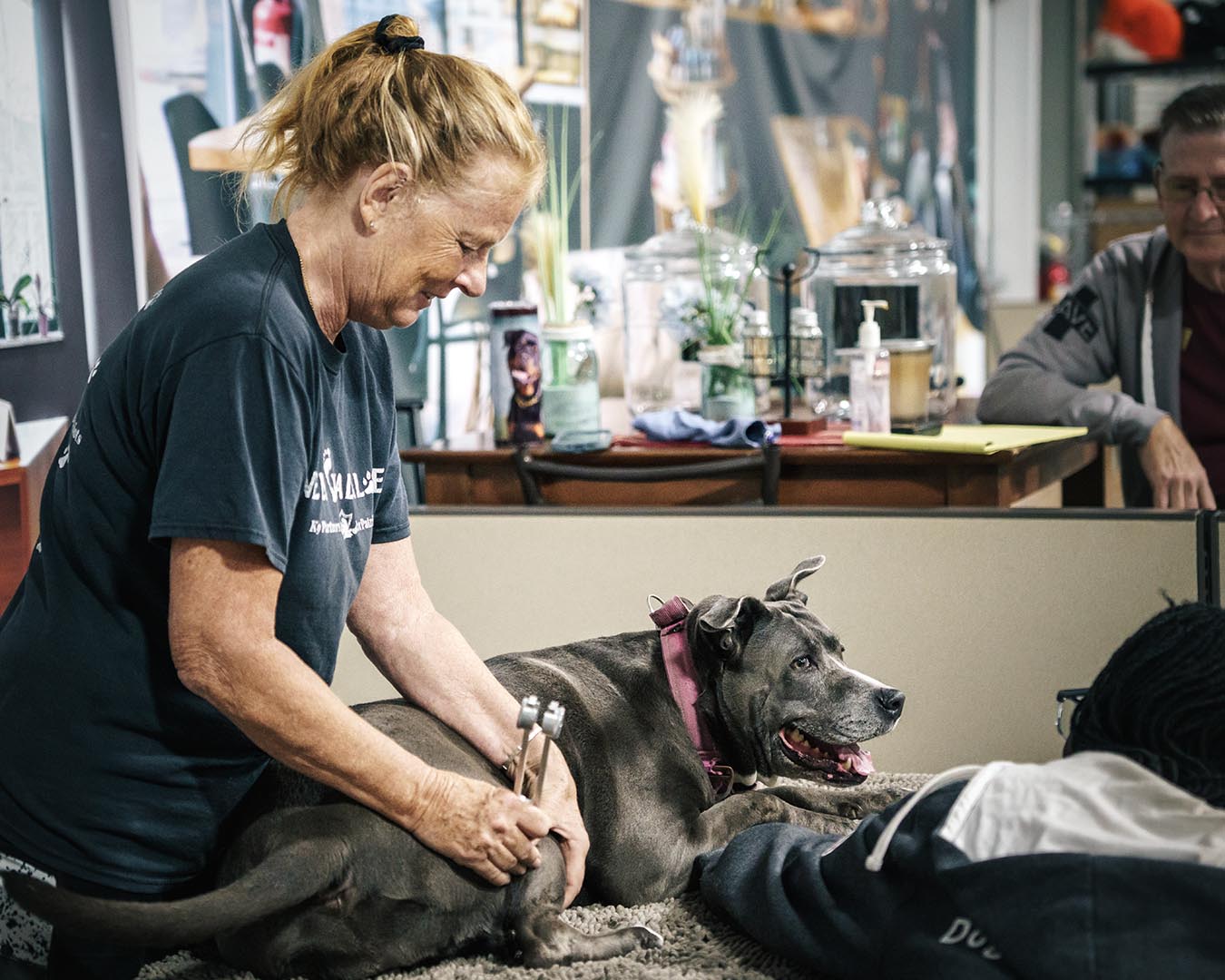
On this day, Vreli is treating Lala, an 80-pound, blue-nose pitbull. Lala’s veteran, Laurie, brings her in on a regular basis for maintenance.
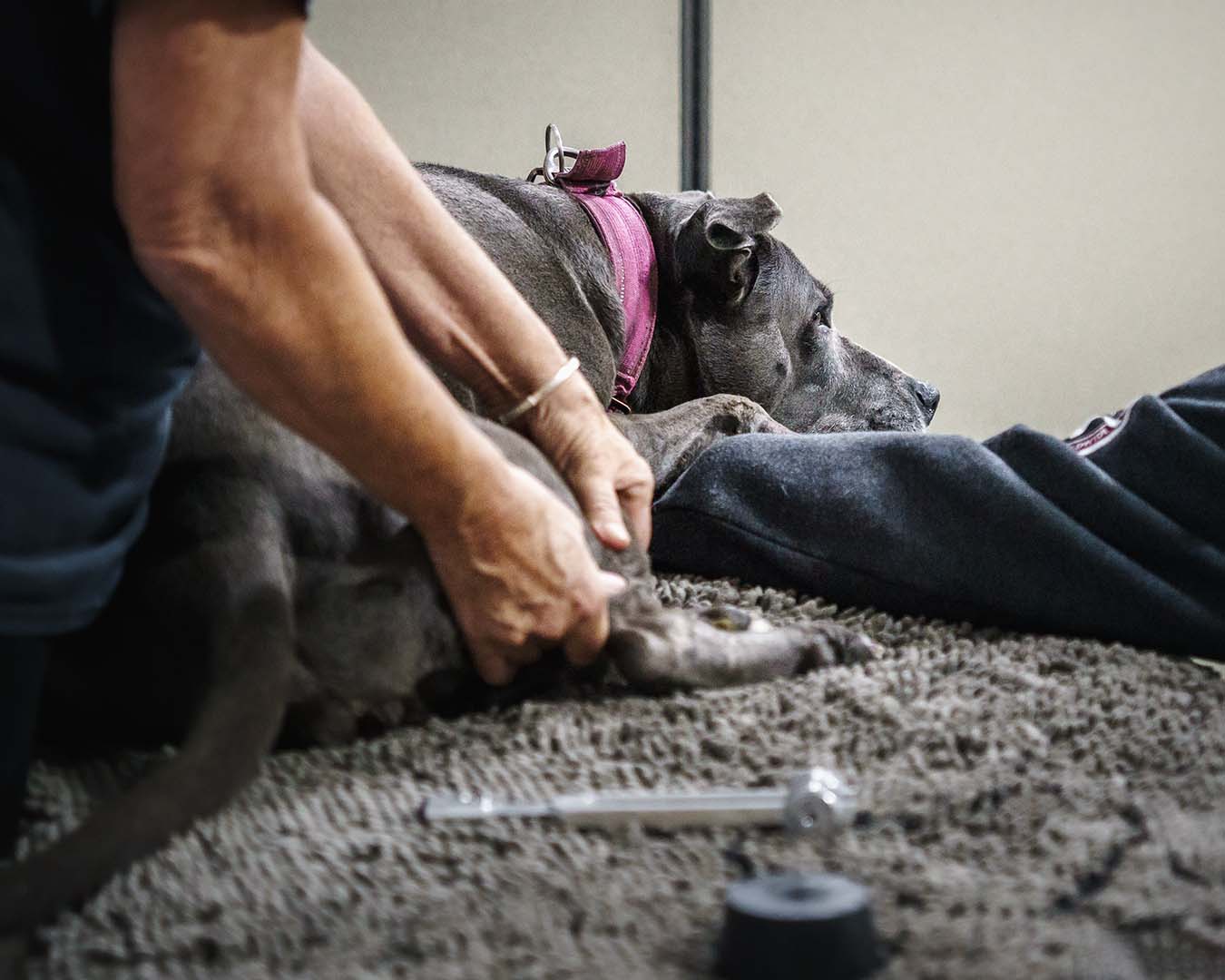
Sometimes it’s very obvious where the area is. Sometimes you stumble on it and you’re not even expecting it. Right now I’m just palpating different muscle groups. Finding out… is it tight? Is there any tension in there, any tenderness? Is there a difference in temperature that might indicate the area is sore? Is it inflamed? Maybe she strained something.
Did you see that little twitch there?
So, down through her back she has some trigger points. It’s a bit like the knot you get in your lower back or your shoulder and you’re digging your thumb in to try and ease it out. Dogs are no different. They have the same issues that we do. Especially when they’re doing the work that service dogs are doing here.
Using a tuning fork, this vibrates and works really well with soft tissue. So if she gets an area that’s triggering it’s like a focal point of tension, which is what those knots are that we get. This is a nice way of releasing all those tissues, letting the blood flow and just cleanse the area and take all the toxins out; rather than the traditional kneading of the area with pressure on it.
If you put pressure on an area that’s really sore, it might be beyond the dog’s tolerance in which case you’re going to know about it! They’ll try to push you away; wriggle and turn over and try to avoid that area getting worked. Whereas with this, it’s a very calming vibration. It releases all those fibers that are getting congested and allows the blood and the circulation system just to pull everything out.
What do I see most frequently?
Tightness of muscles. Sometimes strains where they’ve slipped. Or, they’re doing repetitive tasks; they get a repetitive strain injury. With those sorts of things, you’ll see tightness in the back. A lot of dogs sit next to their handler and they’re looking up. Well, if you sat holding your phone under your chin and neck, you feel the tightness building up. When a dog sits looking up at you all the time, it can compress the area. You get the buildup and feel the knot forming. It’s good to keep all those muscles and all those fibers loosened up. Because what will happen is, over time, they’ll compensate. They’ll be holding their head in a way that relieves the pressure because the area is sore and the opposing muscle on the other side is then stretched, which it normally wouldn’t be. And then you’re going to get tightness and contraction there.
Especially through the training side of things; if they’re running around they might slip and pull a muscle in their back. There’s tightness that will contract but then when they go to walk, they’re compensating so they might swing out from their hip or you might see some lameness or a hitch in their giddyup… And then you’re telling your dog to sit and it’s not doing it.
So, is it a training issue or are they hurt?
That’s why it’s a good idea to come and check them over. I can identify any areas; feel different textures in the muscles so I know if they had a strain in the past, if there’s scar tissue. And that way if we know about that we know what we need to do to keep them warmed up before we do anything. The handler can get involved and just do a little light massage. I can show them how to work the area and just keep it loose.
You always want good muscular health and that way the dog is comfortable when it’s training and muscular soreness or tightness doesn’t become a training issue.
These dogs are their veteran’s lifeline; it’s like having a car that you’ve got to maintain.
If they don’t, if the dog breaks, then they don’t get to go out. They don’t have their partners to take them out. I think it’s really important (massage therapy) and that more of the veterans should take advantage of that.
If the dog is a little off in the way it’s moving… with what I do and as a trainer, you recognize it. You just might catch a little thing out of the corner of your eye, where ‘oh, that’s something that wasn’t quite right’. Not everybody has that kind of eye. The trainers here are used to watching dogs move and they know when a dog is off. But the dogs are very good at hiding it.
We had one earlier today; the trainer spotted something that was not quite right and I found a couple of things on her this morning and I’m hoping the handler is going to take her to see a chiropractor. He’ll follow up with that, and again, you’ve got to be a mechanic! You’ve got to follow up on your dog.
Sometimes you can see it and it’s not the work they do that’s created the problem; but activities of daily living; i.e., jumping on/off furniture, in and out of vehicles.
The number one cause of injuries?
Slippery floors. They’re racing through the house, they slide on the floor. Over the years I’ve worked on numerous dogs that have slipped and then they can’t walk. And you get them walking again.
Keeping an eye on things like that. Being aware. Running across a tile floor or wood floor is quite hard for dogs. They’re ‘digitigrade’. That means they basically walk on their toes. So if you’re up on you toes and trying to walk on ice, it’s pretty hard and all of your muscles are coming into play. That’s what it’s like for dogs walking on slippery floors. The muscles are under a lot of strain because of that. It just takes one slip and it can tear.
Just being aware of things like that and throwing down non-slip rugs on the main traffic ways to stop that. Not playing ball in the house. There are other things, like when they’re playing out in the yard, running, stopping and twisting their bodies when they turn… that can cause problems.
It’s the environment at home or what they’re doing for exercise that can be the issue. At the end of the day, they need to be dogs! But, we want to avoid the horror stories and be aware of what possible damage they’re doing…
- Jumping up and down on beds;
- Up and down from furniture;
- In and out of trucks;
- and any high places
It’s a lot of force into the body. When they jump high to something and then come down to the floor and everything slows down and comes up… you can see just how much their limbs are pushed to their extreme. Doing that on a repetitive basis can do damage.
That’s why we recommend ramps. You add that to the equation when you’re looking out for your dog’s longevity and the dog’s body.
We’ve found some injuries with some dogs. We have one coming in later where found a cruciate tear. We’ve had others, different things over the years. Broken bones. One of our veterans called, ‘there’s something wrong, he’s limping.’ She came to the house and I gave her a quick check over and… ‘oh yeah, he’s broken his toe.’ I’ve found broken bones a couple of times. Sometimes it just goes in stages. That was the second one I had that week.
Sometimes you discover things where they have to go to the vet. But if we find it early we give them much more of a fighting chance to get over something.
Again, be mindful of things that can be an issue. Particularly with larger dogs. Most people with small dogs tend to lift them into their car anyway. With bigger dogs, watch them jumping in and out of the vehicle. Jumping up and down on furniture; running around in the house.
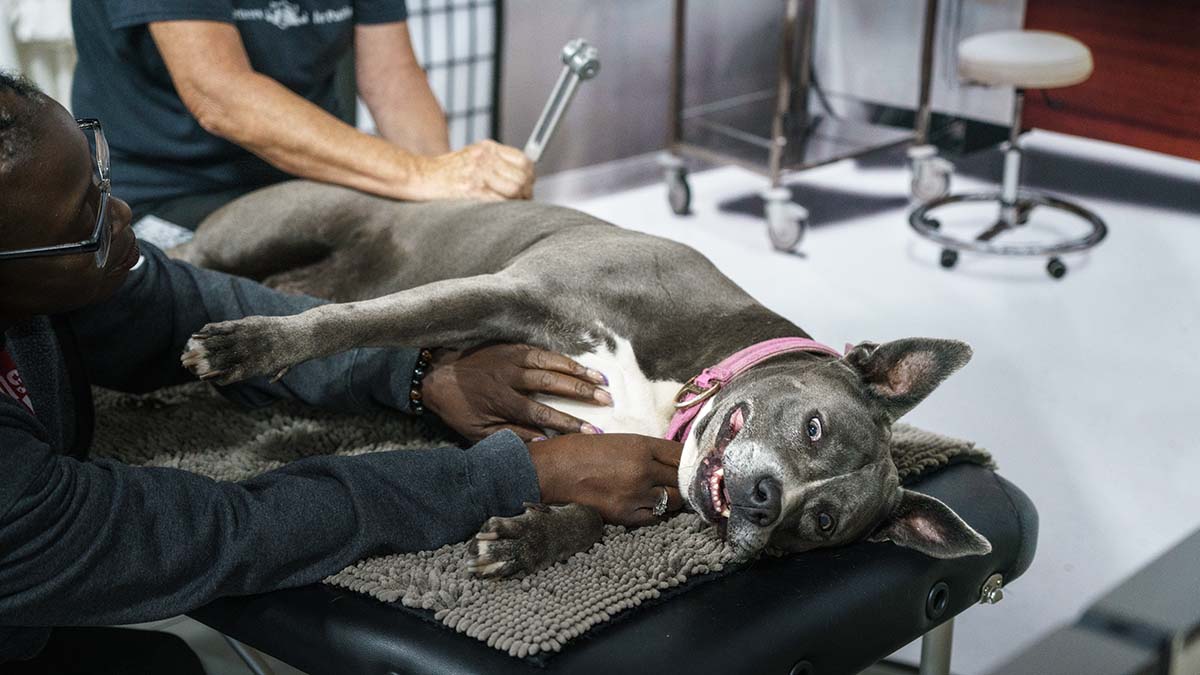
Watch your dog and what they do.
Try and become aware of their gait and how they move. And if you see something is a little bit off that can be your dog trying to hide something. They’re very good at hiding things! Survival of the fittest. ‘Nothing wrong with me… limp, limp! We see that.
With Lala, she’s got a nice short coat. But some of these dogs with just a slightly longer coat, like just right there, there’s a natural swirl with her. But sometimes that can indicate a muscle injury. So just keep an eye on your dog’s coat so if you get a little swirl or the coat kicks back a different way from what it normally does, maybe take a picture so you know what your dog’s coat pattern is. And if you look at it and you don’t know if it was like that previously… then you’ve got something to refer back to.
With Lala I’ve found lines along here where the coat comes up like that… the follicles get impeded by the tautness of the muscle and the hair grows a different way.
If you run your hand down your dog, you saw her twitching earlier, so that’s a trigger point. We’ll use this (tuning fork) she loves it, she finds it relaxing…it gets rid of all those trigger points.
It’s a vibration. Everything with massage therapy is vibration. You just literally use your hands; your finger and just manually vibrate it. But it’s very hard work on my body. And that manual vibration doesn’t go as far. That (tuning fork) hits the deeper muscles as well. It’s a magic wand! A lovely tool, it’s taken my practice to another level. It really has.
If I hadn’t worked on Lala we wouldn’t know she had scar tissue. And at some point it would tighten up. So, we keep that supple and she’s going to be good to go! That way Laurie can maintain her correctly for what she’s got going on.
Dogs are stoic. A lot of them will not show you anything. They may not reach as well, or drive as well from the rear so you watch that. Are they short on their stride? Are they crossing over or are both legs moving together as opposed to moving on a diagonal then that usually indicates something is not right.
I watch them when they come in. I want to pinpoint it. If it’s something we can manage here then, fine, and if not, maybe you need to go see a vet about it.
And it can be little things. A toe might be slightly misaligned, not totally but slightly, and if the toe is out of alignment that can put them into a limp or not want to sit; or stand; or turn in a certain direction.
Someone might see something and say ‘we need to go back to training’ and I say check the body out first, it might not be a training issue. Like I said earlier, they have ways of telling us, we just need to be aware and let them.