This Isn't Easy to Do
It isn’t easy to ask for help.
I got out of the Navy in ’94 and went straight into working at a federal penitentiary. For 20 years. I started at USP Lompoc (Lompoc, CA) and then transferred to FCC Florence (Federal Correctional Complex) in Florence, CO.
I started thinking I needed help after my head injury. I had several, but in 2020, it really messed me up. That was after I got out of the service. I ended up at the prison and had another head injury, and then my husband had a DWI and got locked up. Ended up getting a divorce. And my mom died. I lived in Colorado, sold my house, and gave away everything I owned. I knew I needed to get away from everything. I came down here (Florida) 2 ½ years ago, and I couldn’t function; I couldn’t go outdoors. I was completely lost, literally waiting to die.
I was gaunt and gray, smoking weed all the time. I had pain… I didn’t want to think about it, all that happened. I was afraid everywhere I went because I had always been in a group. Always had people everywhere to watch my back. When it was just me, it felt very foreign. The universe was trying to wake me up on a new level.
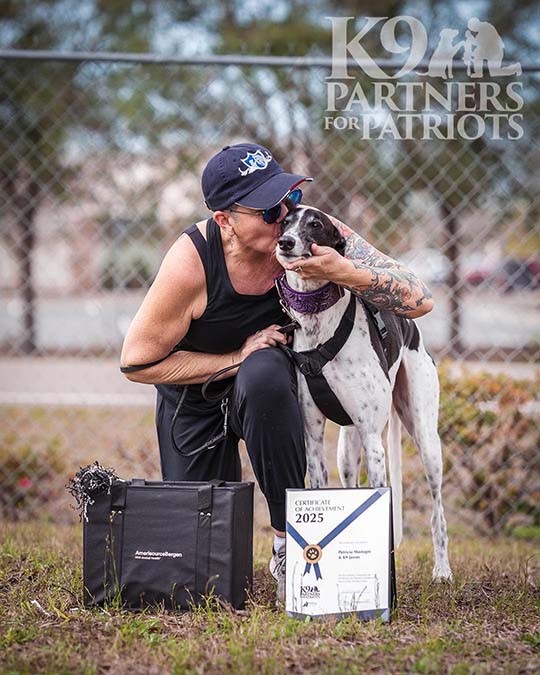
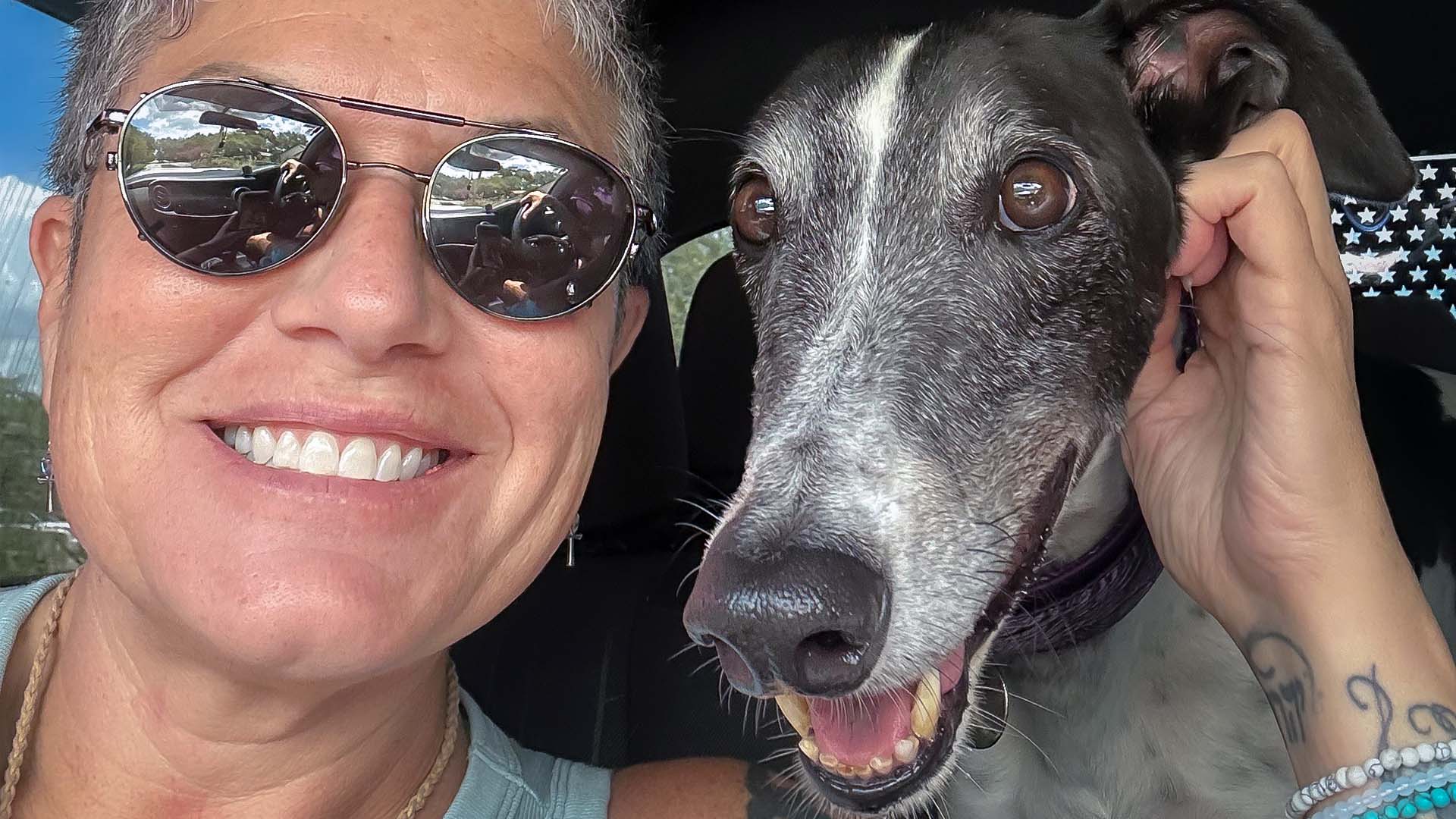
I didn’t have the support at home that I needed and didn’t come out of my house for years. For several years, it was very difficult for me. And I saw this program and thought, OK, I’ll give this a shot. (Jaxon was donated by Gulf Coast Greyhound Adoptions.) Once I got him that’s when I started coming out. Started meeting people and felt more comfortable going everywhere.
We came into K9P4P to have him tested. He’s the perfect height; I need him for stability, especially on my left side. I lose my balance a lot. So I hold on to him and I can readjust. I don’t think I’ll ever be able to hold a job. I have hypermobility, it’s a subset of Ehlers-Danlos called Marfan syndrome that affects my heart and every joint in my body. It’s constant pain. It can come on spontaneously and it’s been really difficult for me. So I’m done, I’m retired.
With the VA I’d been complaining since 2007. There was something wrong and no doctor listened to me. I was pill-popping. A lot of stuff they put us on, it really masks the side effects and we’re not really aware. When you think about the veteran suicide rate, I think the highest is from PTSD but it’s also because of the lack of treatment from the VA. We’re pawns. All they want to do is give you pills. It’s always more drugs and that’s the last thing we need.
‘If you’re suicidal, call this number!’… that’s the first thing you hear when you call the VA. How does that help us? They pull all your trauma out and then they let you out the door. And now you’re left thinking about all that stuff. The veteran should be allowed to bring it out but the VA wants to pull it out and put it in all their little boxes. And they leave a highly traumatized vet to go out the door.
They have dropped the ball on me medically so many times, I had to start advocating for myself and fighting for myself. I wouldn’t have been able to do that if I hadn’t had him (Jaxon).
“…I didn’t get my old life back… I got a new one.”
When people ask me, I didn’t get my old life back… I got a new one. So I’m single now, I wasn’t single before. Self-isolating, that was my problem. I felt nothing. I felt like a heavy weight was on me. I couldn’t breathe. And he gave me a purpose.
When I went through the training here I cried. I was emotional. And for a while I couldn’t come because my body wasn’t working right. But I got through it. It wasn’t hard because Jaxon was such a great dog, but emotionally.
During the training we went to Target and Publix and he did great. I had already been taking him everywhere with me and he did great right out of the gate. I was more nervous about how he was going to do. It took me a while to have confidence in him because giving away control is not my strong suit.
The first day I couldn’t get him to stop whining… I was in tears. But after a week he fell right in. The problem is when they start whining and you’re stressing, our adrenaline goes up and a lot of us start getting very stern with our dogs.
What Tish Wants Other Veterans to Know
GL: Did it take time to learn how to read your dog’s behavior?
TM: It did. We grow over time. I knew his behavior but I didn’t know the depth of his sensitivity when I started here. This is the most sensitive dog. He’ll do anything you ask him, he’s good.
Reading the dog, if he was stressed, I was stressed. If he was calm I was calm. And for me to tell where I was at I’d have to look at my dog because I did not have the self-awareness at the time. I still struggle with that.
I wouldn’t say I’m 100% better but my body is finally able to heal. I get muscle spasms and my joints go out and I’m getting better, I have less of that as time goes on. And it’s probably because I’m not alone.
He doesn’t necessarily respond to me like other dogs… he’s a retired racing dog from Australia. So he doesn’t know how to be a dog; he doesn’t socialize like other dogs, but reading his energy when I need help, I know what he’s telling me. By watching how he’s behaving, I can tell where I’m at. And I thought that was just the strangest turn of events. I had no idea that was going to happen. And now I can get out of my house and drive my truck. I don’t have to smoke weed all day anymore. That was seven years’ worth of me trying to cover up my emotions.
GL: What would you say to the head of the VA?
TM: If you really cared about your veterans you’d allow them a way to heal and dogs can do that. They help with mental health. He helps me with everything. It’s not even a year yet, but I wouldn’t have made it if I hadn’t gone here. I was fully waiting to die.
If I’m unsteady, if I’m not doing well, I won’t lash out; I’ll touch my dog. You touch him, you feel him breathing, it’s grounding for me. It pulls me from my head. I have a purpose now. I have something that’s greater than me and my problems.
This (Jaxon) is a tool that helps us survive, and you’re not allowing us to have that tool. You are not supporting your veterans by not letting the ones that need them, because they’re not going to make it. They’re not going to thrive in life. They will never thrive unless they can get past the hump, and the only way they can do that is by feeling that you’re not alone anymore.
GL: Any advice for veterans in the program?
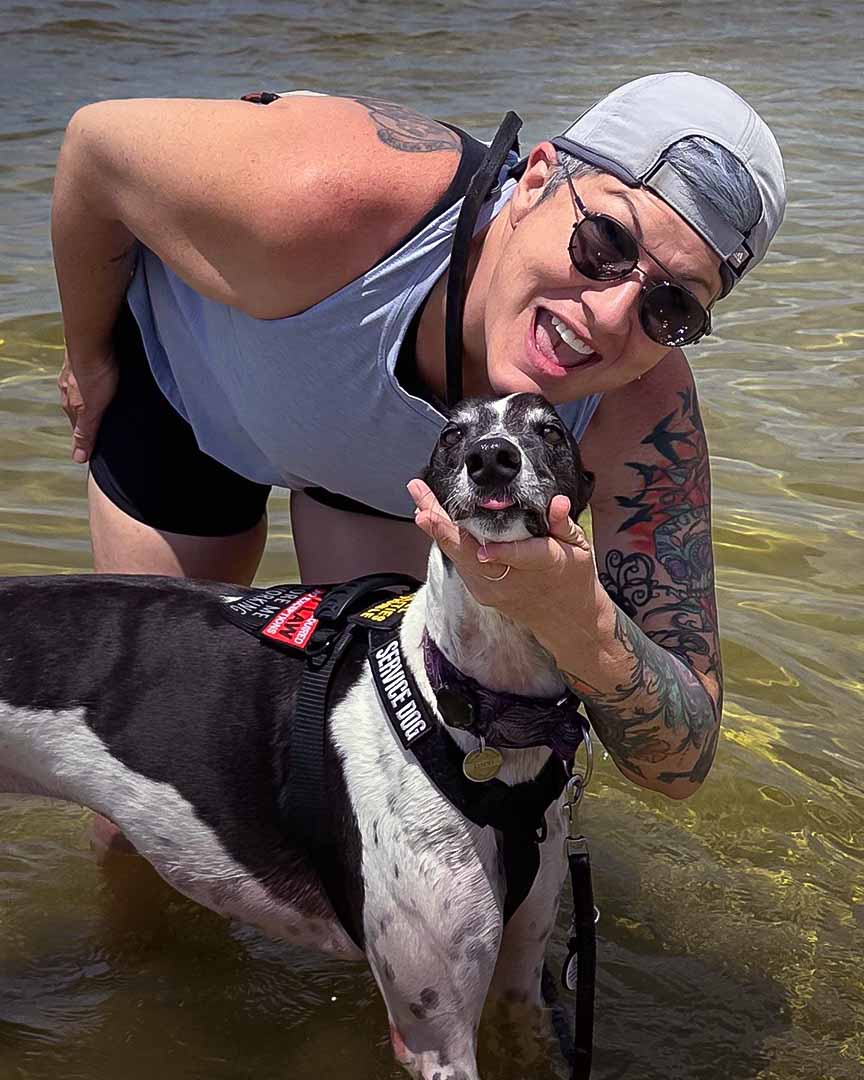
TM: Don’t worry about your dog. Your dog will learn. Don’t quit. Give it time. Your dog knows. And you’ll know when your dog knows. You’ve got to have confidence in that animal. He showed me how wrong I was. Everything that we’ve done with him, he’s thrived at. Even when I go to the beach, I’m not stable in the water, so he’s helping. He’ll walk with me and drag me out of the water!
For those who are worried about coming here and think that they’re weak, you’re not weak. You’re strong. You’re saying, you know, I need help. I’m not good where I’m at. And when you don’t say that, you stay where you’re at.
For those who are worried, come and watch. Hang out and ask how they’re doing with their dog. There’s no reason you shouldn’t come in here if you need help. It was hard for me at first. I cried a lot. It’s not that I couldn’t get him to do things; I didn’t know how to do it.
I thought I was doing something wrong. You’re not doing anything wrong. You’re here, that’s the hardest step, just getting here! The training comes smoothly.
I have a boyfriend now. This man I met, Jaxon, was obsessed with him… we just kept bumping into each other on walks. And, actually, Jaxon likes Ron more than he likes me! He loves his daddy now, but he listens to me. He always listens to me. I have all the control.
It gives you a sense of purpose. A sense of power again. That might sound weird, we don’t want power, we don’t want control, but you’re doing it. You know? You are doing it. You’re regaining purpose. You’re going to get your life back. It doesn’t happen overnight. It comes slowly. But it does come. Don’t be afraid to ask for help.
Training Jaxon, I felt like I accomplished something. That was the greatest sense of accomplishment I had, the only one I’ve had in seven years, was our graduation! I give him all the credit.
Every veteran with PTSD should have the ability to get a dog if they need one. There are certain levels of PTSD, and we all have our triggers… If I hear a gunshot, I freak out. Loud noises, keys jingling, or if I see somebody running, I still have issues. But I can handle them a lot better with him by my side.
The timing was perfect, everything just fell into place. Everything falls into the right place if you think about it. The progress I made with Jaxon, oh my God, it’s life-changing. I’m a totally different person now. I would say 100% more under control than when I got here. He’s not just ‘a dog’, it’s a life-support system for us. I should have done it sooner!